The professor of biomedical engineering and surgery will advance collaboration among engineering students, clinicians and industry professionals for the M.Eng. in Medical Device Development, a nine-month degree integrating hands-on prototyping experience with clinical immersion and entrepreneurship coursework.
Meet the engineering undergraduate students working at UC Davis Tech Foundry. In this Q&A, Allen Cooke, David Kou and Haelie Tweet share how they are gaining technical skills while helping transform ideas into real-world solutions. Together, their experiences reflect a new chapter for a space that is actively growing.
Through a capstone design project, students work alongside clinicians, engineers and business mentors to translate healthcare challenges into market-ready technologies, gaining experience in the clinical, regulatory and business aspects that underpin successful medical device development.
Through clinical shadowing, hands-on engineering and industry collaboration, two graduate students share how clinicians, engineers and industry professionals have equipped them with the necessary tools to take a medical device from idea to a clinical application advancing human health.
High school students from the Capital region will be invited to explore biotechnology, AI and precision manufacturing through hands-on learning experiences at UC Davis in a program led by Professor of Biomedical Engineering Marc Facciotti.
The nine-month degree, part of the UC Davis Department of Biomedical Engineering, combines courses in engineering and design with entrepreneurship and leadership, offering experience equivalent to five to seven years in the medical device industry.
From bioengineering and medical device development, the next chapter of UC Davis' innovation story is set to unfold at Aggie Square. Here is a look at three innovative teams and programs connected to the College of Engineering that are getting ready to call it home.
The Cube³ Lab, part of the Department of Biomedical Engineering, has developed a new course for first-year students to build community as they learn about and find solutions to the issues women face in engineering.
The annual UC Davis event, hosted by the Biomedical Engineering Society and the Translating Engineering Advances to Medicine Lab, allows undergraduates to apply their engineering skills and receive hands-on experience in product design and prototyping.
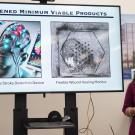
The Quarter at Aggie Square Biomedical Engineering cohort wrapped up their 10-week experience with a presentation of three medical prototypes for growth-accommodating heart valves, noninvasive glucose monitors and stroke-detection devices. The students chose the concepts to solve complex health challenges they encountered.