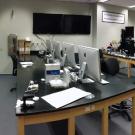
Around 200 people attended the TEAM Design, Prototyping, and Fabrication Facilities Open House and Launch Party on Jan. 15.
After introductory remarks by TEAM Director and Biomedical Engineering Department Chair Kyriacos Athanasiou, several TEAM clients gave short presentations about their collaborations with TEAM.
Biophotonics is a highly interdisciplinary field that investigates the fundamental principles of the interaction of light with biological organisms, tissues, cells, and molecules and develops new technology for basic science and clinical applications based on these principles.
A new paper by Soichiro Yamada, a professor of biomedical engineering at UC Davis, addresses a simple question, “What happens when single epithelial cells contact their own membrane versus the membrane of neighboring cells?”
The meteor that exploded over Chelyabinsk, Russia, in February 2013 was “a wake-up call,” according to a University of California, Davis, scientist who participated in analyzing the event. The work is published Nov. 7 in the journal Science by an international team of researchers.
“If humanity does not want to go the way of the dinosaurs, we need to study an event like this in detail,” said Qing-zhu Yin, professor in the Department of Earth and Planetary Sciences at UC Davis.
Martin Judenhofer, a project scientist in the Cherry Lab, has received the IEEE 2013 Bruce Hasegawa Young Investigator Medical Imaging Award. The award is given to one individual each year for their research accomplishments in medical imaging. The prize citation was “For contributions to small-animal imaging instrumentation and the development of preclinical simultaneous PET/MRI scanners”. He received the award at the IEEE Medical Imaging Conference in Seoul, South Korea 27 Oct – 02 Nov 2013 .
Laura Marcu, a professor in the UC Davis Department of Biomedical Engineering, has been named “Domain Leader” of the UC Davis branch of the University of California BRAID (Biomedical Research Acceleration, Integration and Development) Center for Accelerated Innovation.
A hawk circles lazily in the morning sky outside the window of biomedical engineering Professor Marc Facciotti’s office, overlooking a scenic, tree-covered part of the UC Davis campus. It’s cozy and warm with natural sunlight, which seems appropriate because we’re talking about opsins, light sensitive proteins. You are probably most familiar with the opsin – called rhodopsin – that serves as a photoreceptor in your eyes.
Non-wetting fabric invented in Tingrui Pan’s MiNI Lab at UC Davis Biomedical Engineering was the centerpiece of U.S. Rep. Jerry McNerney’s plea in Congress for continued federal funding of scientific research this morning.